
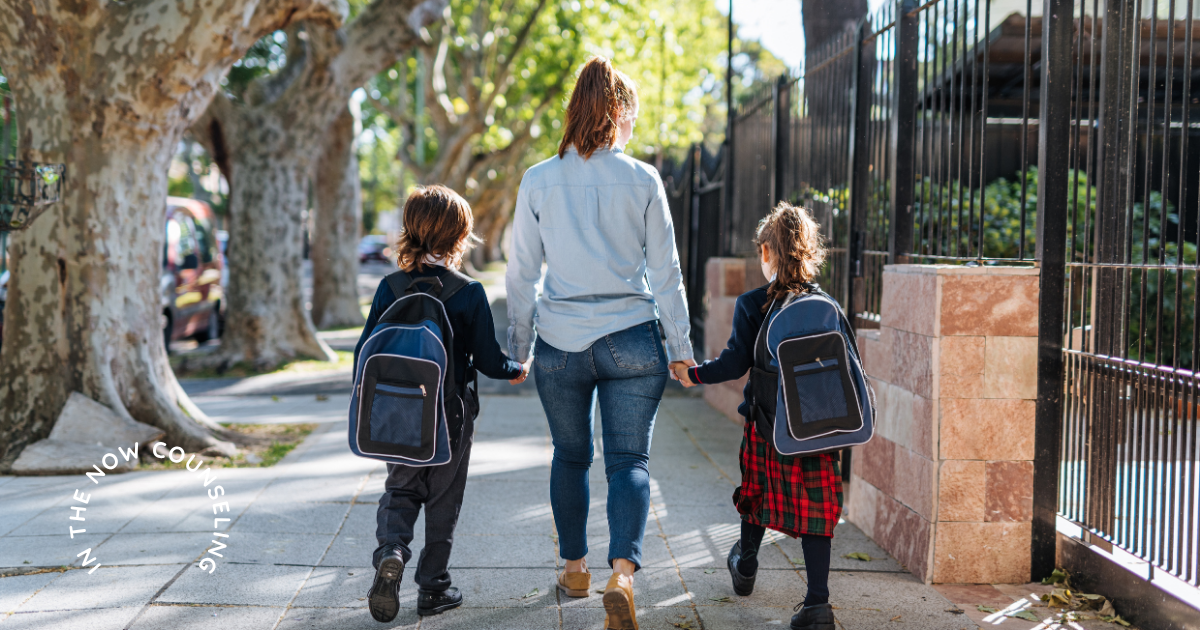
Is your child more emotional after starting school? Learn why school can overwhelm kids and how to support big emotions with less stress.
The school year has started, and you may have noticed something you weren’t expecting.
Your child comes home emotional since starting school this year.
Maybe they’re crying over something small. Maybe they’re suddenly angry, irritable, or frustrated. Maybe they have a meltdown over homework, refuse to get ready for an activity, or seem completely exhausted by the end of the day.
And you may find yourself wondering:
“What is going on with my child?”
The good news is that this doesn’t necessarily mean something is wrong.
Sometimes, your child is simply running out of emotional energy.
Starting school again requires a lot from kids – not just academically, but emotionally, socially, and physically. For some kids, that means they spend the entire day working hard to manage their emotions, follow expectations, navigate friendships, pay attention, transition between activities, and handle the many little frustrations that come with a school day.
By the time they get home, there may not be much emotional energy left.
School Takes More Emotional Energy Than We Realize
Think about everything your child has to manage during a typical school day.
They may need to:
- Sit still when they want to move
- Pay attention when they’re tired or distracted
- Follow directions
- Wait their turn
- Handle disappointment
- Ask for help
- Navigate friendships
- Manage conflicts
- Transition from one activity to another
- Follow classroom rules
- Keep their emotions under control
- Work through things they find difficult
That’s a lot.
And children are still developing the skills they need to manage all of this.
Emotional regulation is a skill that develops over time. It isn’t something children either have or don’t have.
So when your child falls apart after school, it may not be because they had a “bad day.”
It may be because they had a very hard-working day.
Why Your Child May Fall Apart at Home
You might notice that your child seems perfectly fine at school but becomes a completely different kid once they walk through the door.
This can be confusing—and sometimes frustrating.
But home is often where children feel safest. It’s where most of us feel safest.
Your child has spent hours managing expectations and holding it together. Once he/she gets home to the people they trust, all of those feelings may finally come pouring out.
That might look like:
- Crying over something that seems insignificant
- Becoming easily frustrated
- Yelling or arguing
- Meltdowns
- Clinginess
- Refusing to do simple tasks
- Complaining about everything
- Wanting to be alone
- Seeming unusually tired or withdrawn
This doesn’t mean your child is manipulating you or trying to make your evening difficult.
It may mean their emotional cup is simply empty.
Emotional Regulation Is Not About Being “Good” at Emotions
We sometimes expect children to calm themselves down because we assume they should know how.
But emotional regulation is something children learn through practice and through relationships with supportive adults.
A child who is overwhelmed may not be able to simply stop being angry.
A child who is anxious may not be able to “just relax.”
A child who is exhausted may not have the capacity to make another good decision.
This is where co-regulation becomes important.
Before children can consistently regulate their emotions on their own, they often need an adult to help them feel safe, calm, and understood.
That might sound like:
“You’ve had a really big day. Let’s take a break.”
Or:
“I can see that you’re really frustrated. I’m here. We can figure this out together.”
You’re not rewarding the meltdown.
You’re helping your child get back to a place where they are capable of thinking, communicating, and solving problems.
What If My Child Is Overwhelmed by School?
Sometimes increased emotions after school are simply part of adjusting to a new routine.
But sometimes they can be a sign that school is feeling particularly difficult for your child.
Pay attention if you notice a pattern of:
- Frequent stomachaches or headaches before school
- Trouble falling asleep or staying asleep
- Strong resistance to going to school
- Frequent crying related to school
- Increased irritability that continues throughout the evening
- Withdrawal from friends or activities
- Excessive worrying about school
- A noticeable change in mood or behavior
- Repeated statements that they don’t want to go to school
These can sometimes be signs of school anxiety in children or that your child is struggling with something happening at school.
The goal isn’t to immediately assume there is a problem.
Instead, get curious.
“What is school feeling like for you right now?”
Sometimes the answer is surprisingly simple.
Sometimes it’s a friendship problem.
Sometimes it’s academic frustration.
Sometimes it’s the noise, transitions, or constant stimulation.
And sometimes your child doesn’t have the words to explain it yet.
How You Can Help Your Child After School
If your child is particularly emotional after starting school, try thinking about the first part of the afternoon as a transition period, rather than expecting them to immediately jump into the next thing.
They may need time to decompress.
Try:
Give them a little breathing room.
Not every child wants to talk about their day the moment they get in the car.
Instead of asking ten questions, give them some quiet time.
Offer food and water.
Hunger and exhaustion can make emotional regulation much harder.
Sometimes the snack really does help. It may help to have the snack ready at home, or if you have a long ride, have a snack ready in the car with you.
Reduce demands when possible.
If your child has spent six or seven hours following directions, solving problems, and managing expectations, they may need a little downtime before homework, activities, or chores.
Connect before correcting.
If your child is already overwhelmed, correcting every behavior may escalate the situation.
Start with connection.
“You seem really overwhelmed right now. Let’s take a minute.”
Keep routines predictable.
Children often feel more secure when they know what comes next.
A predictable after-school routine can make the transition from school to home feel easier.
Your Child Isn’t Broken. They’re Still Learning.
If your child has been more emotional since starting school, try not to immediately label them as dramatic, difficult, defiant, or overly sensitive.
Instead, ask yourself:
“What might my child be carrying right now?”
Their behavior is giving you information.
Maybe they’re tired.
Maybe they’re overwhelmed.
Maybe they’re anxious.
Maybe they’re navigating something socially difficult.
Or maybe they’re simply adjusting to the enormous transition from relaxed summer days back to the structure and demands of school.
None of this means something is wrong with your child.
It means they’re human—and they’re still learning how to manage big feelings.
And that learning takes time.
When to Reach Out for Support – Canonsburg, PA Area
You don’t have to wait until your child’s emotions become a major problem before asking for help.
If your child is consistently overwhelmed by school, struggling with emotional regulation, experiencing significant anxiety, or having a difficult time adjusting to the school year, talking with a therapist can help you better understand what’s underneath the behavior.
Sometimes children need support developing emotional regulation skills.
Sometimes parents need support understanding what their child’s behavior is communicating.
And sometimes everyone just needs a little help getting through a big transition.
You don’t have to figure it out alone.
At In The Now Counseling, we believe children aren’t “bad” for having big emotions. They are learning, growing, and developing—and sometimes they need a safe place to work through what feels too big to manage on their own.
If your child is struggling with the transition back to school, we’re here to help.


